Karma Workshop
Breaking Through The Loops | Autumn Satsang Series
Many people are quietly slowing down their own authentic path not because they lack devotion, discipline, or insight, but because they don't actually understand karma.
It shows up in small, familiar ways. Coveting what someone else has, or idolising a person, a lifestyle, a spiritual identity that was never actually part of your karma to begin with and wondering why chasing it never quite lands. Staying in a relationship long after every teaching it had to offer has already been delivered, because leaving feels like failure rather than completion, whilst at the same time feeling stifled, stagnant and unsure why you can't move, when the truth is the karma between you finished a while ago.
Imagine if we had a deeper understanding of karma… It could help us move through integral life changes more seamlessly and to find the gateways to a higher pathway. If we just knew how to spot the signs and how to respond to the inevitably, and in some cases, malleability of our karmic conditions.
What is karma and what is it not?
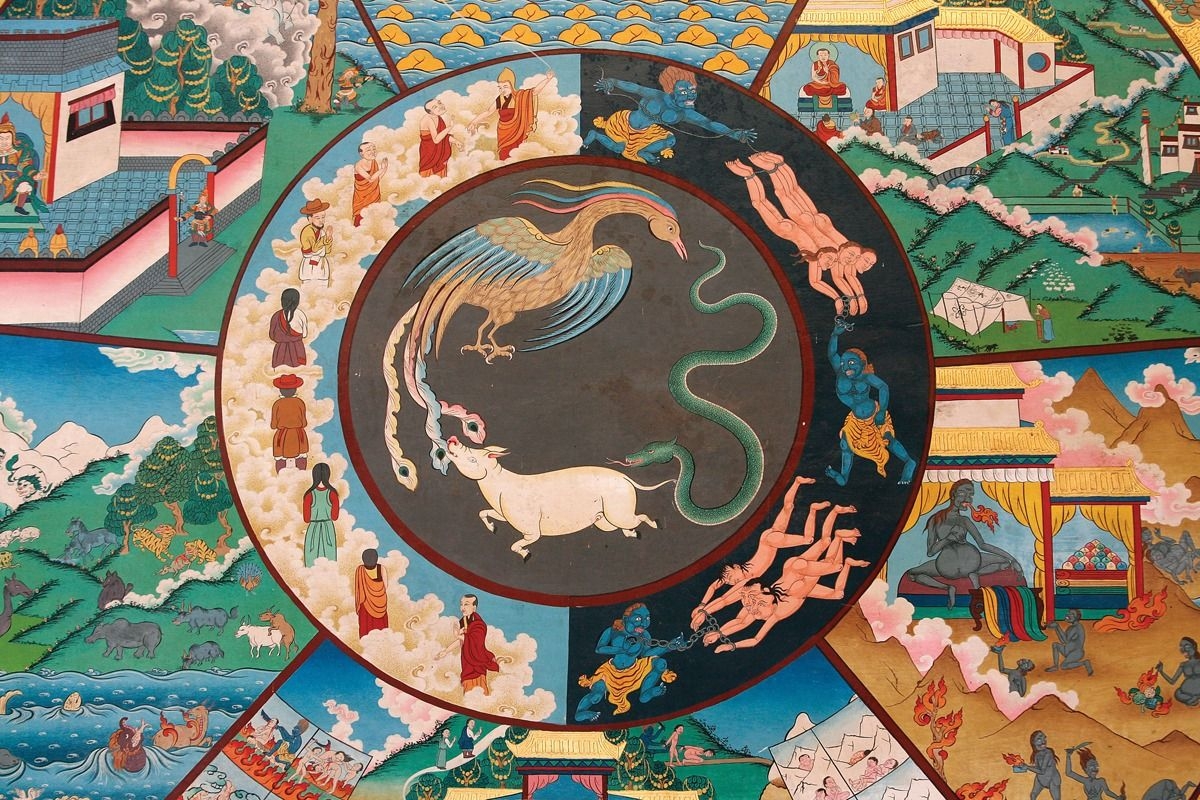
Most people carry a vague, popular version of karma: good deeds in, good luck out or naughty deeds in, bad luck out – a kind of cosmic scoreboard. However, it is not that, karma is a lawful, energetic process of cause, pattern, and consequence, playing out across time; not a punishment, not fate, and not something happening to you from outside. Without understanding that, karma just looks like random bad luck or persecution, and you stay reactive to it instead of working with it consciously.
A key points to ponder here, which we’ll go much more deeply into in our group session which includes a satsang from Padma, breakaway groups (looking at themes mentioned in Dakini Weaving – Keys to the Golden Age) and questions and answers sessions:
Is all karma bad? No. Karma is simply cause and effect, it produces what we'd call fortunate outcomes just as readily as difficult ones. The discomfort people associate with "karma" usually comes from unconscious, repeating patterns, not from karma itself.
Is karma something to be ashamed of? No. Shame keeps you fused with the pattern. Karma is not a verdict on your worth, it's more like a cosmic piece of homework, here to be worked with, not a mark against your character.
What can we actually do about it? Some karma is fixed and simply has to be lived through. A good deal of it is flexible, and responds directly to conscious effort, remedy, and devotion. Knowing which is which changes everything about how you meet it.
How do we become free from it? Not by escaping karma but by changing your relationship to it. Freedom isn't the absence of karma but it rather is no longer being unconsciously governed by it.
Why this matters if you're a practitioner, seeker, or doing transformation work
If you're doing any kind of serious inner work, karma isn't an optional topic, it's the terrain you're already in. Without a real understanding of it, spiritual work tends to stay conceptual: you can meditate, journal, and set intentions for years and still find yourself blindsided by the same relational rupture, the same collapse, the same "meltdown" (as we've named it elsewhere in this series) that seems disproportionate to whatever triggered it. That's not a failure of practice. It's usually karma ripening without the map to recognise it. If we don’t recognise it, we may loop. If we can become more ‘karma literate’ we actually become empowered and active in the weaving of our own lives and those of others.
Karma and impermanence
Hopefully we can all be encouraged by the insight that karma is not permanent. Everything that arises is also, eventually, exhausted, including the karma you're currently carrying. Even karma described as "fixed" is fixed only for its duration; once it's been lived through and met, it's finished. Understanding karma alongside impermanence means understanding that no pattern, however entrenched, is actually eternal. What feels unbearable now is not evidence of a life sentence, it's evidence that something is in motion, ripening, on its way through.
How to spot karma ripening
A few signs worth knowing, so you can recognise it in real time rather than only in hindsight:
– A reaction that's out of proportion to what triggered it
– The same "type" of person, conflict, or opportunity showing up again, in different costume
– A sudden mirror you weren't ready for: something in someone else that lands uncomfortably close to home
– Old wounds or family/ancestral patterns surfacing with no obvious present-day cause
– A relationship or situation that keeps you around long after its teaching has clearly already landed
Join us to do deeper and to become more ‘karma literate’
Karma Workshop — Oct 24 @ 6:30pm UK
Part of the Autumn Book Club series alongside Dakini Weaving – Keys to the Golden Age.
The Looping Problem:
Why So Many "Awake" People Have No Resourcing

There is a particular kind of looping happening right now, and it's not confined to beginners. We're watching senior practitioners – people with years, sometimes decades, of spiritual practice behind them – go into total meltdown over what are, in the scheme of things, first-world problems. More than crisis-level events, it's ordinary friction, and the meltdown is often karmic in nature, such as an old pattern surfacing, a relational rupture or a mirror they weren't ready for. What's missing isn't insight but resourcing, both in terms of ‘trauma tools’ but also in terms of understanding key natural and cosmic law concepts such as karma, decolonisation and natural law style collaboration.
This matters more than it might seem, because a lot of people who consider themselves "awake" or "conscious" have spent significant money and energy building a spiritual identity without building the underlying capacity to actually hold it. And with what may be unfolding in the world in the coming period, that gap is going to show. Insight without resourcing doesn't hold under pressure, it cracks.
Four Places the Looping Comes From
In the lead-up to some book club sessions Padma will be running in the autumn linked to her book, we want to name four areas where we keep seeing people stuck in loops rather than moving through them:
KARMA
Most people have a vague, popular notion of karma – good deeds in, good luck out – rather than an understanding of it as a lawful, energetic process of cause, pattern, and consequence playing out across time. Without that understanding, karma just looks like random bad luck or persecution, and the person stays reactive to it rather than working consciously with it.
DECOLONISATION
Spiritual communities routinely extract from indigenous and traditional knowledge systems while leaving the actual politics, history, and power structures those systems emerged from unexamined. Skipping this work doesn't just create ethical blind spots but it keeps people's understanding of "spirituality" shallow and disconnected from land, lineage, and consequence.
COLLABORATION AND GROUP ENERGETIC
Very few people are taught how to conserve energy in group settings, read collective field dynamics, or apply even the most basic principles of human permaculture – how people, roles, and resources can be arranged so a group sustains itself rather than burning through everyone in it. Most groups leak energy constantly and nobody notices why.
RESOURCING
The one underneath all the others. Without it, karma feels unbearable instead of workable, decolonial work feels like an attack instead of an invitation, and group settings drain rather than nourish.
These four themes – karma, decolonisation, collaboration and human permaculture, and resourcing – are exactly what we'll be exploring in the book club sessions this autumn alongside Padma Khandro's book. Our sense is that the coming period will ask more of people's capacity to stay resourced than it will ask for more spiritual knowledge, and we'd rather see people build that capacity now than discover the gap under pressure.
If you recognise yourself in any of this: the looping, the meltdown that seems disproportionate to the trigger, the sense of having done a lot of spiritual work without quite landing anywhere solid; this is exactly the territory the mentoring, readings, and Quantum Transfiguration work are built to address.
BOOK CLUB DATES
RESOURCING
TBA
DECOLONISATION
OCT TBA – IN-PERSON LONDON – EXTRA COSTS APPLY
LATE OCT/EARLY NOV - DEEPER DIVE
COLLABORATION AND HUMAN PERMACULTURE
OCT 13 @ 6:30PM UK
KARMA
OCT 24 @ 6:30pm UK
WANT TO GO DEEPER?
For those who'd like the more advanced teachings, an optional add-on package is available: a special lecture on the Vedic cosmology of karma, offering valuable insight into mapping your own causality. A rare opportunity to see karma not just as a concept, but as it's actually written into your own chart.
BREAKING THROUGH THE LOOPS
Selected co-inquiry sessions and Book Club on Dakini Weaving – Keys to the Golden Age
These four sessions will explore the themes above alongside relevant chapters from Dakini Weaving – Keys to the Golden Age. Each session will give you an opportunity to engage with the material before coming together for deeper inquiry.
You’ll be invited to:
– Read the relevant chapter of Dakini Weaving Reflect on the questions and themes before the session
– Ask Me Anything session and commentary on sections of the book where relevant
– Explore the material through guided discussion
– Take part in small breakaway rooms for co-inquiry
– Reflect on how these themes may be operating in your own life, practice and relationships
You will be discussing the book chapter "Natural Law, Indigenous Science and Dharma" and in the break away groups, so it is recommended that you have read it if you wish to gain deeper knowledge however it is NOT mandatory. If you are feeling curious about this topic and just want to listen and reflect. Current students with Dharma STARS are expected to have read the chapter, and to be informal facilitators of their break away group.
The aim of these sessions more than just understanding the concepts is to create a space where you can examine the places you may still be looping and begin to understand what might allow you to move through them.
More details on the autumn book club sessions to follow soon with a more detailed breakdown on what Padma will present on briefly in the session and some thought-provoking questions for you to contemplate while you study the relevant chapter for your session.
If you’re reading this and our real time sessions have past or you can’t make it live then you are welcome to purchase the recording of the session. We remind you that the deeper transmissions and opportunity to get your direct questions answered is prioritised to those attending the real-time call.

Dharma STARS
COURSE PRICING
TIER 1
SUPPORTED
£13
Reserved for people who are facing hardship, single parents and from developing countries.
TIER 3
SUSTAINING
£22
For those able to contribute a little more towards sustaining Dharma STARS' educational work.
BUNDLE PRICING
TIER 1
SUPPORTED
£45
Reserved for people who are facing hardship, single parents and from developing countries.
- All four sessions included
TIER 2
STANDARD
£55
The standard contribution for the training.
- All four sessions included
TIER 3
SUSTAINING
£66
For those able to contribute a little more towards sustaining Dharma STARS' educational work.
- All four sessions included
Subscribe to our Mailing list
Be the first to receive the latest updates, news, and exclusive offers.
I have read and agree to the terms & conditions.